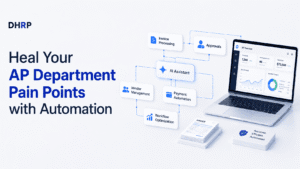
The environment for the accounts payable department is growing more difficult. You’re being asked to perform more than ever before while preserving flexibility to accommodate organizational development, changing work environments, and remote work. You can’t afford to let any of these things slip—accurate payments, controls, compliance, and insight into your AP operation are all crucial. In this blog, We’ll go through why you should think about AP automation now and how it can help you meet your AP operating needs.
- Visibility - Understanding where your bills are in the process, what the next steps are, and maintaining constant visibility into your AP process is all-important.
- Control – Reducing operational risk and promoting your organization's financial health.
- Scalability – The ability of your automation solution to grow and change in response to the needs of your business.
Making it Crystal Clear
Highly manual AP departments typically process about 10,000 invoices approval per person per year, according to an IOFM study of nearly 400 AP practices conducted between 2017 and 2019. However, if the AP team is small and the business grows, that volume can quickly become unmanageable. The day-to-day workload distracts you from key strategic tasks, but the bills must be paid. And, more than ever, AP departments require the ability to perform the same tasks from any location.
Keeping the Track
Moreover, keeping track of where bills are in the approval process is one of the most difficult challenges for many organisations. Who owns them? Who is supposed to approve them but hasn’t? Where is the bottleneck? A manual system provides little visibility into the AP process, creating black holes where invoices disappear, become stalled, and are not paid on time. Aside from digging through files and hoping to find a missing document, there is no efficient way to retrieve information about a specific invoice or vendor.
And if some invoices have an exemption from approval, it is often impossible to verify unless the AP specialist memorises the manual setup. What should be a streamlined process can quickly lead to payment delays.
As a result, many businesses have adopted automated payment and invoice processing solutions that provide complete transparency, allowing teams to track where invoices are in the workflow, who has handled them, and where delays occur. To evaluate the effectiveness of these improvements, organisations should monitor key performance indicators for AP teams that measure efficiency, processing speed, and overall accounts payable performance.
The solution’s two-way communication enables better collaboration between AP teams and approvers, helping ensure invoices are paid on time. Rather than relying on endless email chains, users can view all ongoing conversations, screenshots, and document attachments in a single application. This is further strengthened by a fully connected mobile app, allowing employees to stay on top of pending invoices even while working remotely.
Staying in Control
Control and compliance are critical considerations for sustaining your company’s financial health, but they’re often forgotten in a rush to keep up with manual invoice payments. However, managing operational risks with a small staff can be extremely difficult. A manual procedure, at its most basic level, carries a high risk of making a mistake. Even if everything is in order, it’s all too simple to pay the same invoice twice, especially if you asked for a resend because you couldn’t locate the original. Because it takes so long to check that every invoice hasn’t already been paid, manual operations rarely do so—and then pay it again.
Automation, on the other hand, simplifies the procedure. Once you’ve entered the invoice into the system, it recognizes it and won’t let you make a duplicate payment. The best performers in this area can keep duplicate payments to less than 1% of the time, while the worst performers issue duplicates payments more than 3% of the time. This can be prohibitively pricey.
Not only should an automated system prevent duplicate payments, but it should also be able to handle exceptions. Utility and mobile bills, for example, may need to be paid straight away to guarantee that services are maintained without having to go through the typical approval routing process. The software must be able to recognize and manage those bills correctly.
Your ROI
Automation isn’t only about efficiency; the savings in terms of error reduction and compliance should more than compensate for the costs. Those who automate their processes can lower their per-invoice processing costs by nearly half.
Get In Touch
With targeted automation, top-performing small-to-medium-sized businesses may more than treble their per-person invoice processing.
You get tangible benefits that go right to the bottom line by considerably enhancing productivity and reducing invoice processing costs. It becomes a good business decision when combined with increased compliance and control, which reduces the risk of penalties and fraud. Furthermore, if you need professional help or guidance for Microsoft Dynamics 365 accounts payable workflow or vendor invoice automation d365, DHRP has the team to help you with it.