An evaluation that is done based on a feature checklist and a demo walkthrough is a solution to the wrong problem. The most important question for 2026 is not which platform has the most functionality, but which platform works where your business lives, and how it will perform with AI workloads, and what it will actually cost the business for 5 years later.
The quick response is that organisations that already use Outlook, Teams, SharePoint, and Azure will benefit significantly from Dynamics 365 sales in the long term. For more complex, global, multi-cloud sales processes, where more workflow customisation, a greater ISV ecosystem, and platform independence are more important than simplicity of integration, Salesforce is a better choice.
The longer response relates to data architecture, AI foundations, the often-overwhelming licensing costs, and the harsh reality that most CRM implementations do not succeed because of the CRM system, but because the organization was not prepared for it. In this blog, we will talk about Dynamics 365 Sales vs Salesforce from various perspectives.
Use of Feature Fit and AI Infrastructure
The AI conversation in the CRM is no longer about features but about context – where the AI is and where it is getting its information from.
Copilot is built on the Microsoft Graph, giving you the ability to access Outlook email, Teams meetings, SharePoint documents, and Dataverse records all in one place. It’s a real plus, rather than a visual effect; salespeople can get deal updates and information without changing tools.
The Salesforce strategy is different: They’re taking a different tack with Agentforce, which focuses on developing AI agents for specific use cases, like case routing or lead qualification. It’s the ideal approach when the sales context is intricate and demands an excessive amount of control over the workflow and AI actions. However, it must have strong data structures, well-organized processes, and often, professional oversight to function on a large scale.
This is a common mistake made by many organizations: they believe that AI implementation is straightforward and occurs once the system is purchased. It doesn’t. AI is only as effective as the information and processes on which it’s built. The results are impacted by the bad use of the pipeline or inconsistent usage on both Salesforce CRM vs Microsoft Dynamics, but the results are still usable on top of Microsoft’s data context.
Cost is another consideration: Copilot is frequently a part of Microsoft 365, while Agentforce offers a usage-based pricing model that can rapidly increase in high-volume situations and affect the total cost of ownership.
Data Model Architecture
This is where the comparison is relevant. Microsoft Dataverse is more than just a CRM database; it’s a common data resource that can be shared across the Dynamics 365 Sales, Dynamics 365 Finance, Dynamics 365 Service, and the Power Platform. Data created during sales is securely available in real time to modules like Power BI, Power Automate, and ERP. It’s not about systems syncing; it’s about working from a single source of truth, which is going to transform the way teams access and trust data. The impact is felt on the job. Payment history can be accessed during a deal, and service teams can see all customer interactions without integrations or delay.
Salesforce Data Cloud is the unification layer at the heart of Sales, Service, and Marketing Clouds, which has an object-centric approach. It is a force to be reckoned with, but it is costly, has configuration overhead, and data unification can be delayed between creation and unification.
Performance of the AI
AI models such as Copilot or Agentforce leverage readily available and connected data to provide accurate insights. When data is distributed across multiple systems, the AI will generate partial responses. These gaps are rarely identified in demos but become apparent after the project has been implemented but decisions have been made on the basis of incomplete information.
Over-customisation
Over-customisation is one of the common pitfalls. It’s great to get as much information as you can, but too many extra fields and complexity can confuse. Both salesforce vs microsoft allow this, but it’s much easier to ensure data quality across teams in Dataverse, with Power Platform governance providing support.Salesforce allows for more flexibility at the object level, which is helpful. However, if it is heavily customized at the beginning of practice, it might result in rework later on. There’s nothing better than flexibility, but no governance; that’s more of an investment into technical debt, and that will cost you more later.
Integration Ecosystems
There’s a very fine line between platform gravity and workflow gravity. Salesforce has a strong platform gravity; it’s a force that draws processes to it. It also has thousands of applications on its AppExchange, which is great for organisations looking to invest in the Salesforce platform to create a Salesforce operating model.
On the other hand, Microsoft Dynamics 365 Sales embraces workflow gravity. It integrates with existing tools such as Outlook, Teams, and Excel. Sales activities occur in familiar interfaces, such as emails linking to opportunities, pipeline reviews through Teams, and approvals in Power Automate. This helps to minimize friction and makes the learning curve shorter.
Think of a real-life situation. A rep who completes a call could close the record, enter notes, send follow-ups, and update forecasts on various tabs and tools in Salesforce. This context switching is costly and burdensome even when automated. Much of this can occur within Outlook, as an embedded CRM context, and Teams can record calls and automatically retrieve transcripts from Copilot. Deal summaries are already surfaced the following day.
These differences occur on an individual basis and appear insignificant on their own. When they are applied on a large scale, for a whole sales team, for a whole year, they become measurable gains of efficiency and increased CRM use. People resist tools that look like reporting tools but use embedded tools in the daily workflow.
There are integration trade-offs for both Microsoft Dynamics versus Salesforce. Salesforce has a very large API ecosystem, which can be tricky to navigate without a ton of middleware, such as MuleSoft or Boomi. Microsoft’s Power Platform has a lower cost of integration, but a greater dependency on Azure increases in the long term. There is no neutral choice, only alignment to your strategic direction.
Total Cost of Ownership
The costs of Salesforce are relatively easy to grasp, yet they add up rapidly. Additionally, features such as advanced analytics tools, increased API usage for integrations, and paid sandbox environments, as well as specialized developer demand, drive up costs beyond the standard license. The scarcity of skilled Salesforce developers adds to Australia’s longer-term reliance on partners at a higher cost.
Organisations with an existing investment in Microsoft 365 may find the incremental cost of Microsoft Dynamics 365 Sales to be less. Many Power Platform and Dynamics licenses include many of the reporting, automation, and AI features, eliminating the need for specific tools. Azure alignment also enables infrastructure and AI workloads to reside in existing cloud agreements, aiding spend control.
But the single most important cost driver is not licensing, it’s quality of implementation. Any platform is prone to doubling or tripling the true cost in just 12-18 months if it is poorly designed, overly customised, and poorly governed. In practical terms, the capabilities of a partner in the Australian market can have a more significant financial influence than selecting the software.
What Most Dynamics 365 vs Salesforce Articles don't tell you?
The majority of CRM failures are due to adoption and not technology. Platforms generally do work; organisations don’t. Executives see demos of clean data, seamless processes, and instant AI analysis, but not the months of data cleansing, process redesign, and change management that get them to this point is the journey.
A frequent error people make is to try to customize before rectifying the faulty sales process. The CRM will simply highlight that if there are issues with forecasting or pipeline discipline, they are there. AI tools for both Dynamics and Salesforce are completely reliant on data quality, and without good data governance, they are of little to no true value.
During a vendor demo, it’s not typically what it says it is: clean data, flawless migration to legacy, seamless integration or high adoption rates. This is why it is important to select one based on operational reality and not presentation scenarios.
As for leadership evaluation, they should assess how ready the data is for the AI, how ready the internal team is for the platform, how extensively Microsoft 365 is being used, experiences of partners who dealt with similar organisations, and the evolution of licensing costs once the data has been used.
How to Decide Between MS Dynamics vs Salesforce?
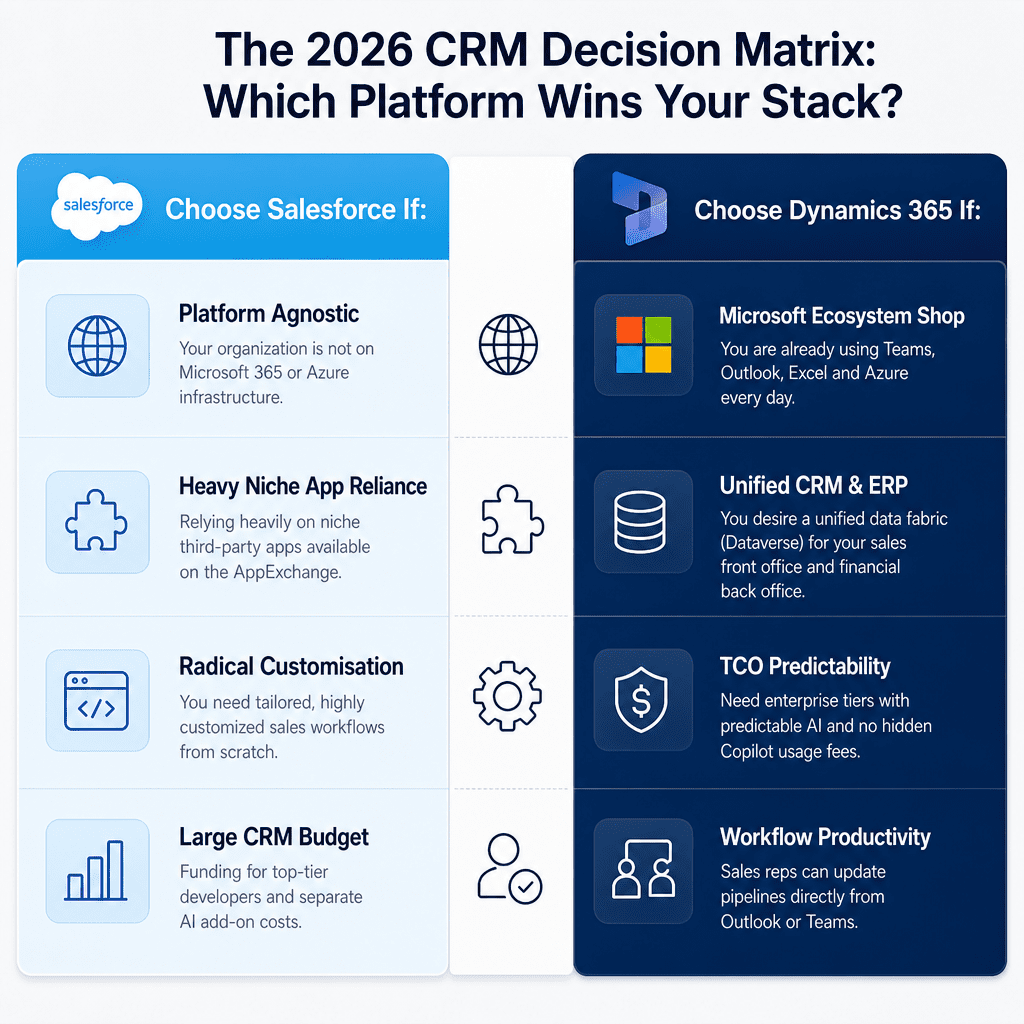
If your organisation is already using Microsoft 365, Azure or a Dynamics 365 ERP module, then Dynamics 365 Sales is the better option. It is ideal for Australian businesses in the middle tier without significant in-house IT resources, sales teams that operate in Outlook and Teams, and organisations that require CRM-to-ERP integration without a high cost of middleware. When ready-to-use TCO and common data layers in Finance, Business Central or Supply Chain are important, then Dynamics is the right choice.
When your sales processes are more complex, non-linear, and the need for in-depth customization starts from scratch, Salesforce becomes a more suitable choice. It is also more suitable for businesses that depend on AppExchange integrations, for companies with existing skills or a strong implementation partner in Salesforce, or for companies that wish to remain cloud-vendor agnostic, instead of being bound to the Microsoft ecosystem. Another telling indicator is industry verticals that have custom Salesforce ISV solutions.
Dynamics 365 Sales is the preferred default platform for mid-market businesses in Australia, when considering the predictability and depth of integration of the Microsoft ecosystem, where there is no commitment to either platform. Salesforce makes its good money where it actually provides operational value, not brand familiarity.
Conclusion
In 2026, Dynamics 365 vs Salesforce is no longer a question of features, it’s a question of fit. Salesforce is more expensive and more complex to integrate, and better for organisations that have high customisation needs, internal expertise or partners, and have complexity across the globe.
Predictable cost, ease of data alignment, and tighter integration make Microsoft Dynamics 365 Sales more suitable for mid-market businesses that are utilizing Microsoft 365 and Azure.
FAQs
The base price is similar to Microsoft Dynamics 365 Sales; however, the overall price may differ between Salesforce. Salesforce has add-ons for AI, analytics, sandboxes, API scalability, and so on that add to the cost and increase as time goes on.
Microsoft is more “bundled” if the organisations are using Microsoft 365 and Azure. To increase the ROI of automation and tools with Power BI and reduce the need for additional tools to make the process effective.
Salesforce is great when there are more complex processes or larger companies that have CRM departments. It offers lots of benefits including its ecosystem and flexibility. Now, Dynamics 365 is bridging the gap, particularly when it comes to CRM and ERP alignment and integration latency.
Yes, for most typical CRM requirements. Dynamics 365 Sales is a pipeline, forecasting, reporting and AI assistance platform. Yet Salesforce still shines when it comes to the depth and customisation. The level of difficulty of Salesforce customisation and integration affects migration.
Microsoft users will find Dynamics 365 Sales to be better suited for them, as it’s integrated natively with Outlook, Teams, SharePoint, and Power BI. Use familiar tools at work to enhance adoption. Salesforce is working, but requires additional layers of integration and training, which increases complexity and cost.
Microsoft Copilot for Dynamics 365 utilizes Microsoft Graph to deliver a more contextual view of email, meetings and documents, creating more cohesive insights in any Microsoft environment. Salesforce Agentforce is more flexible and easier to set up and govern for custom AI agents. In most organizations, Copilot provides more immediate benefits.