Modern marketing has many trends, from viral loops to growth hacking, but most of them start overnight and end just as quickly. But some trends persist for decades until the whole shift in marketing occurs.
This is where you ask yourself if you have a strategy to fit right in. In this, one of the marketing strategies that comes in handy is the omnichannel strategy. It isn’t just about keeping everyone in the loop; it’s about remaining ahead of the times.
Can your system forecast the pattern? Or does your CRM software have the ability to make each customer experience worthwhile? If not, you are missing the strategy.
So, how to integrate into your CRM? Previously, we explored CRM trends 2025 and discussed CRM Implementation ROI. Today, we will take this further and talk about Omnichannel CRM strategies in detail.
Let’s take a look at it and discuss how Dynamics 365 Omnichannel strategies can help businesses like yours.
Why are Omnichannel CRM Strategies Important?
Modern marketing isn’t about a straight line. Your customers now move between the apps, socials, emails, and stores mostly in a single buying journey.
Their expectation of brands is to remain consistent across those channels, conveying the same brand story and delivering the same quality.
If your brand fails, your customers leave. So, the question now shifts too: is your Dynamics 365 customer experience strategy strong enough to survive the year 2025 and beyond? Only if you plan it right.
4 Game-Changing Trends You Need Now
These are not merely trends; they are more than just nice features:
- AI That Truly Gets Customers: Machine learning is only improving every day. Now you can get personalised suggestions, as it can dig into datasets that have never been explored before.
- Voice and Conversational AI are Everywhere: Think of chatbots that can smoothly transfer to human agents whenever necessary, with support teams getting all the context they need right away. Besides, voice shopping is set to go mainstream.
- Real-time Data Updates: Customer profiles should refresh instantly at every point of contact. No more “hold on, let me check that.”
- Predictive Journey Mapping: AI should be able to foresee where customers are headed next and be ready for them even before they ask.
What Makes Dynamics 365 Omnichannel Different?
Dynamics 365 Omnichannel uniquely stands out from teh traditional multi-channel systems. They offer a smooth customer journey by offering:
- Customers can pick up exactly where they left off, regardless of the channel.
- Agents get access to the complete conversation history from start to end, especially with mobile-first CRM solutions.
- With the Dynamics 365 CRM and data compliance, data moves smoothly between chat, voice, SMS, and social media.
- AI tools improve efficiency while making customers happy.
Key Capabilities That Actually Work
So, what actually works after the Dynamics 365 CRM omnichannel implementation?
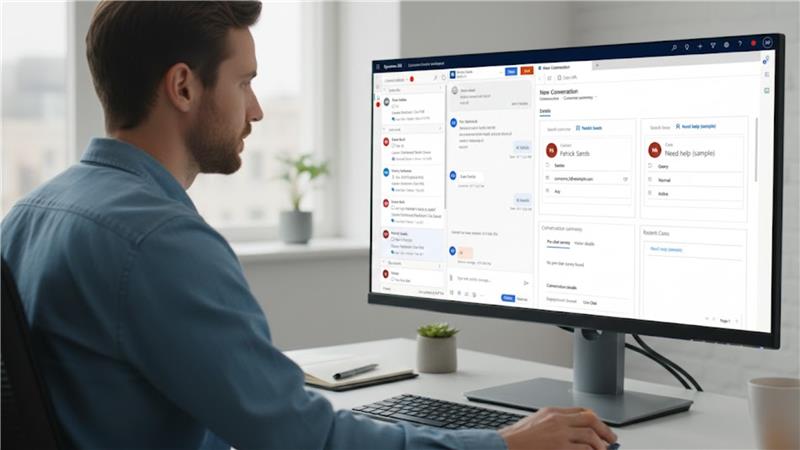
- Unified Agent Workspace: Picture your customer service team using a single dashboard that handles chat, voice calls, SMS, and social media all at once. No more jumping from one platform to another, and definitely no more losing track of where you left off. It’s all about providing smooth and efficient service.
- Intelligent Routing: Forget the old-school call routing. With Dynamics 365, AI helps connect customers to the best-suited agents based on their skills, language, and expertise. The outcome? Quicker resolutions and much happier customers.
- Real-time AI Assistance: Thanks to Copilot integration and the power of AI in CRM software, agents get immediate help with call transcription, sentiment analysis, and suggested replies. This isn’t just a nice feature to have; it really helps lift service from average to exceptional.
- Cross-Channel Insights: Supervisors can access real-time dashboards that show what’s going on across all channels. They can monitor how agents are performing, identify bottlenecks, and make informed decisions to enhance service quality.
How to Deliver Seamless Customer Experiences in 2025
To create a seamless experience, you need more than just the right tech. It also takes well-coordinated processes, motivated employees, and a solid strategy.
Key Pillars of Seamless Engagement:
When planning omnichannel strategies, here is what needs your focus:
1. Real-Time Customer Context
Teams can quickly access a customer’s past actions, purchases, preferences, and requests, all in one place. With unified CRM platforms like Dynamics 365, there’s no need to switch between different apps.
2. Connected Channels Everywhere
Customers really decide how they want to interact, rather than sticking to one brand. To keep up with that, omnichannel CRM strategies 2025 line up everything:
- Social media
- SMS
- Mobile apps
- Live chat
- In-store systems
- Contact centers
When all these channels are consistent, it makes things smoother and boosts customer satisfaction.
3. Automation Helping Human Services
Automation definitely makes processes faster, but you can’t overlook the importance of personal connections in customer service. With AI and workflow automation in play, employees can dedicate more time to meaningful interactions that really matter.
4. Predictive Insights
By integrating AI into CRM tools, companies can anticipate customer needs rather than just responding to issues as they arise. These predictive models can fine-tune marketing and service strategies across various platforms.
Real Results: What You Can Expect
Companies that use Dynamics 365 Omnichannel CRM are noticing:
- 30% quicker resolution times in every channel.
- First-contact resolution rates have increased by 25%.
- AI support has increased agent productivity by 40%.
- Substantial decline in customer effort scores.
Conclusion
Implementing Dynamics 365 CRM with Omnichannel CRM strategies is no longer optional—it’s essential for businesses aiming to deliver seamless customer experiences in 2025.
By carefully planning your Dynamics 365 CRM implementation and balancing CRM implementation cost with expected ROI, companies can unify customer interactions across email, social media, chat, and in-store systems.
DHRP provides CRM consulting services to guide businesses through implementation, helping integrate AI, predictive insights, and intelligent routing into their workflows.
The result is higher customer satisfaction, improved agent productivity, and consistent brand experiences across all channels, ensuring your business stays ahead in the evolving digital environment.
FAQs
The best strategies include unified customer data, connected channels, predictive insights, automation, and AI-driven recommendations. Dynamics 365 Omnichannel CRM supports these for consistent, high-quality experiences.
It provides unified dashboards, real-time AI assistance, intelligent routing, and cross-channel insights, ensuring agents handle customer interactions efficiently and deliver seamless, personalised experiences on every platform.
Identify key channels, integrate data, implement AI-powered workflows, train staff, monitor performance, and continuously optimise customer journeys to maximise engagement, satisfaction, and overall CRM ROI.